

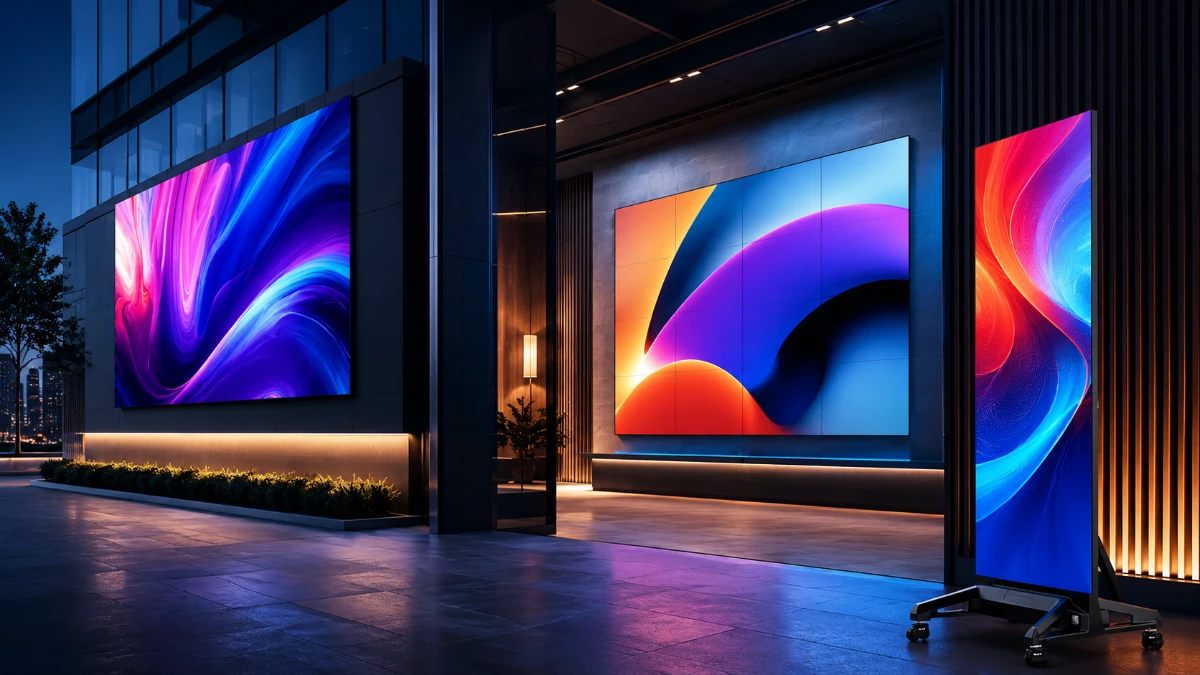
For this reason, LED screens have become an important part of modern commercial façades. They give businesses a practical way to display changing messages, present campaigns, highlight offers, and support brand visibility in a more direct and flexible way.
An LED screen on a façade can do more than display content. It can help people recognize the brand, understand what is being offered, and decide whether the place is relevant to them. When selected and installed properly, it becomes part of how the business communicates with people passing by.
This article explains how LED screens support commercial façades, the main benefits they provide, the types of screens commonly used, and how different sectors can make practical use of them.
The façade is not only the outer face of a business. It is also a communication space. It tells people where the business is, what kind of experience they may expect, and whether there is something worth noticing.
In busy areas such as malls, retail streets, hotel entrances, food districts, and exhibition venues, a business often has only a few seconds to catch attention. A clear and well-placed LED screen can help deliver a message during that short moment.
Unlike static signage, an LED screen allows the content to change. A store can show a seasonal campaign in the morning and a special promotion later in the day. A restaurant can display lunch offers during the afternoon and dinner visuals in the evening. A hotel can welcome guests, promote events, or guide visitors through the same display system.
This flexibility makes LED screens useful for businesses that need to keep their façade active and relevant without constantly replacing printed materials or fixed signage.
A commercial area is full of visual messages. Store signs, posters, lighting, movement, and people all compete for attention. An LED screen helps a façade stand out when the message is clear and the content is designed properly.
The screen can display the brand name, logo, product visuals, campaigns, or short messages in a way that is easy to notice from a distance. Over time, this repeated visibility can help people remember the business, even if they do not enter the location immediately.
For brand awareness, consistency is important. The screen should reflect the brand’s visual identity, including its colors, tone, and type of message. When the displayed content feels connected to the business, the façade becomes more recognizable and easier to remember.
One of the strongest advantages of LED screens is the ability to update content quickly. This is especially useful for businesses that run frequent promotions, seasonal offers, product launches, or limited-time campaigns.
A retail store can change its screen content to match new arrivals. A café can highlight different products depending on the time of day. A restaurant can promote a special menu item, while a mall can use LED screens to guide visitors toward current events or tenant offers.
This flexibility gives marketing teams more control over the façade. Instead of depending on printed posters that take time to produce and replace, messages can be adjusted based on campaign schedules, customer behavior, or business priorities.
However, content should remain simple. A façade screen is often viewed by people who are walking, driving, or passing quickly. Short messages, clear visuals, and readable text usually perform better than crowded designs.
LED screens can also help improve the visitor experience. They can display directions, opening hours, welcome messages, event information, menu highlights, or service announcements. When the content is useful, the screen becomes more than a promotional tool.
For example, a hotel entrance screen can welcome guests and show event details. A mall storefront screen can highlight current offers and make it easier for visitors to understand what the store provides. A restaurant screen can display key menu items before customers enter, helping them make faster decisions.
A good façade screen supports the visitor before they step inside. It reduces confusion, creates interest, and gives the location a more organized and active appearance.
Choosing the right type of LED screen depends on the façade itself, the lighting conditions, the available installation space, the viewing distance, and the way people will see the content. Some façades need a screen that can be seen clearly from a distance. Others need a solution that works with glass, curves, entrances, or interior storefronts. Below are the main types of LED screens that can be used for commercial façades and related spaces.
Outdoor LED screens are suitable for exposed façades, mall entrances, commercial streets, and locations that face daylight and surrounding environmental conditions. This type of screen requires suitable brightness, a durable structure, and an installation method that considers safety and maintenance access.
Outdoor screens are commonly used to display advertisements, campaigns, brand messages, public announcements, and changing promotional content. They are a good option for projects that need clear visibility from a medium or long distance, such as large retail façades, outdoor restaurants, hotels, and commercial centers.
In some projects, the façade is located indoors, such as storefronts inside malls, exhibition entrances, reception areas, or enclosed commercial spaces. In these cases, indoor LED screens are often a suitable choice because they provide clear viewing from shorter distances and work well with indoor lighting and interior design.
Indoor screens can be used to display products, offers, welcome messages, wayfinding content, or short-term campaigns. They are suitable for projects that want to make an interior façade more active and visible without using a high-brightness outdoor screen.
Fixed LED screens are suitable for façades that need a permanent and stable display solution. They can be used on exterior façades, interior walls, entrances, or spaces where content is displayed on a daily basis.
This type of screen can be produced in different sizes depending on the façade area and the purpose of the display. It is suitable for brands that need a continuous platform for advertising, announcements, seasonal content, or brand communication.
Poster LED screens are a practical option for smaller façades, entrances, corridors, and points of sale. They are suitable for retail stores, restaurants, and cafés that need a standalone screen to display daily offers, new products, or quick promotional messages.
Poster screens can be placed inside the space, near the entrance, behind a glass front, or in a waiting area. They are useful for projects that need changing visual content without installing a large screen across the full façade.
Logo LED screens give brands a stronger way to present their name or logo, especially on façades, entrances, and reception areas. These screens can become part of the visual identity of the place and help make the logo clearer during the day and at night.
This type is suitable for stores, restaurants, cafés, hotels, showrooms, and branches that want to present their identity in a more refined way than traditional signage. It can also be used in locations where the logo is a key element in the façade design.
Cube LED screens are used when a project needs a different visual element within the façade area or close to it. They can be placed at exhibition entrances, malls, display areas, or commercial events to present content from more than one side.
This type is suitable for campaigns that need to attract attention quickly, or for projects that want to add a visual object inside the space. It can also work well for product launches and special promotions, where the cube becomes part of the visitor experience rather than a standard display.
Creative LED screens are suitable for façades that require a non-standard shape or a custom design. They can be built in different forms according to the project concept, whether as a curved screen, an artistic installation, a geometric display, or a screen integrated into the architectural design.
This type is suitable for malls, exhibitions, distinctive retail stores, restaurants with a strong visual identity, and spaces that need a solution connected to the character of the place. Creative LED screens can help make the façade more memorable when design is part of the message.
Flexible LED screens are suitable for curved surfaces, columns, corners, and designs where flat screens are not the right fit. They can be used in interior façades, mall entrances, reception areas, or commercial spaces with curved architectural lines.
The value of this type is that it allows the screen to follow the shape of the place. When the façade or surface is not straight, a flexible LED screen can present content in a way that works with the design instead of forcing a traditional rectangular format.
Rental LED screens are suitable for temporary façades, exhibitions, conferences, product launches, and commercial events. They can be used to create a digital backdrop, a temporary display façade, a promotional platform, or a main screen for an event.
This type is important for projects that need a strong visual presence for a limited period without a permanent installation. It is also suitable for seasonal campaigns inside malls or outdoor events that require screens that can be installed, removed, and adjusted according to the event space.
Transparent LED screens are suitable for glass façades, where digital content needs to appear while keeping a sense of openness inside the space. They can be used in retail stores, exhibitions, hotels, showrooms, and buildings where glass is an important part of the design.
The main advantage of this type is that it brings content into the architectural façade without fully blocking visibility. Transparent LED screens are most effective when the content is designed specifically for glass surfaces, with short messages, balanced movement, and clear visual contrast.
The decision should begin with the façade, not with the screen name. Is the façade indoor or outdoor? Will people see it from a short or long distance? Is it made of glass or a solid wall? Is the use permanent or temporary? Is the goal to present the brand, promote offers, guide visitors, or create a visual point of interest?
When these questions are clear, choosing the right LED screen becomes more accurate, and the final solution becomes closer to the actual needs of the project.
In retail, LED façade screens can help highlight new products, promotions, seasonal campaigns, and brand messages. They are useful in malls where visitors pass by many stores and need a quick reason to stop or enter.
For mall environments, screen placement should consider walking paths, viewing angles, and the speed at which people move through the space. A clear message that can be understood quickly is often more effective than a detailed design.
Restaurants and cafés can use LED screens to display menu highlights, special offers, product visuals, and opening hours. A screen near the entrance can influence a customer’s decision before they enter, especially when the visuals are clear and relevant.
For food and beverage businesses, the content should be simple, appetizing, and easy to read. The screen should support the identity of the place without overwhelming the façade.
Hotels can use LED screens on façades, entrances, and reception areas to welcome guests, announce events, display directions, or promote services. This is especially useful for hotels that host conferences, weddings, exhibitions, or business events.
In hospitality, the screen should feel aligned with the environment. Brightness, motion, and content style should be selected carefully so the display adds value to the guest experience.
LED screens can strengthen commercial façades by making messages clearer, increasing brand visibility, supporting promotional campaigns, and improving the visitor experience. Their value depends on choosing the right screen type, placing it correctly, and preparing content that suits the audience and location.
The best choice starts with understanding the façade itself: its size, lighting, viewing distance, audience movement, and business purpose. A screen that fits these conditions can become a useful part of the façade, not only as a display, but as a daily communication point between the project and its audience.
For businesses planning to develop their façades with LED screens, Ultra View can help study the location, define the right screen type, and create a visual solution that serves the project’s needs and audience.