

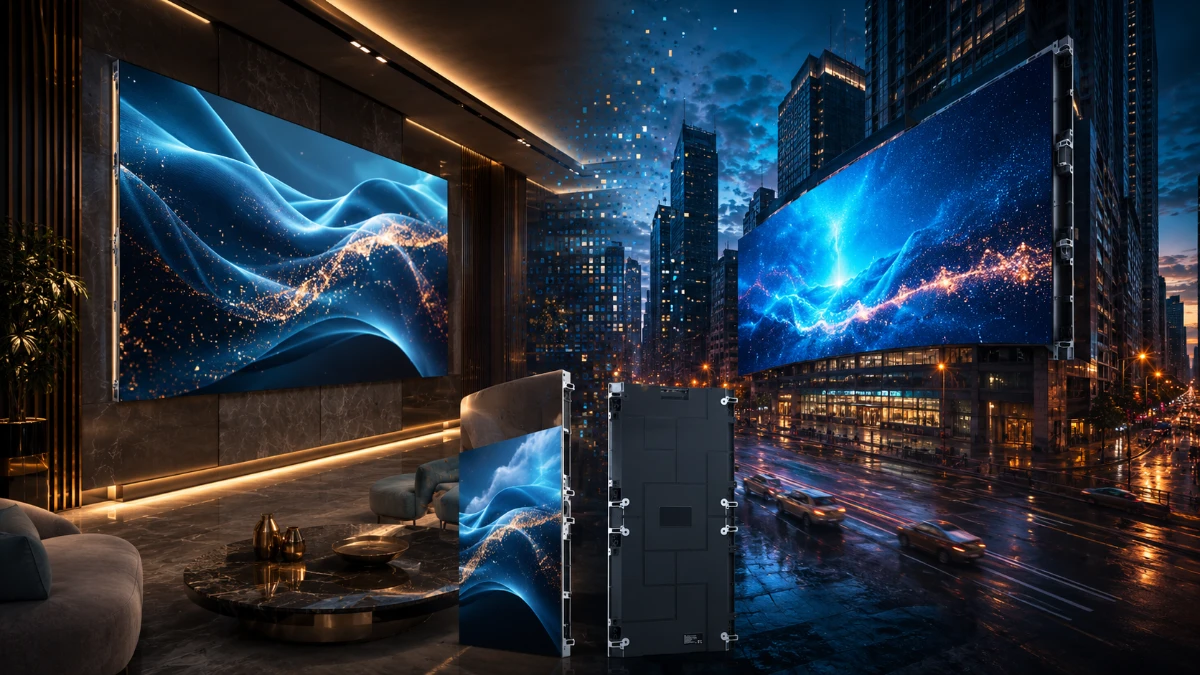
Both indoor and outdoor LED screens can serve important roles in visual communication. They can display advertisements, guide visitors, support presentations, present products, or strengthen the presence of a brand. However, each type is designed for a specific environment. A screen that works well indoors may not perform properly outside, and an outdoor screen may feel too bright or visually heavy in an indoor space.
This guide explains the main differences between indoor and outdoor LED screens, including brightness, viewing angle, installation requirements, durability, and common uses. It also helps you understand which option may be more suitable for your project.
Brightness is one of the clearest differences between indoor and outdoor LED screens. The screen must be bright enough to make the content visible in its actual environment, but not so bright that it becomes uncomfortable for viewers.
Indoor LED screens are usually installed in controlled environments such as malls, meeting rooms, hotels, restaurants, cafés, retail stores, reception areas, and exhibition halls. These spaces often have artificial lighting, and in many cases, the viewer is close to the screen.
For this reason, indoor screens do not usually require extremely high brightness. The goal is to provide a clear image that is comfortable to view from a short distance. If the brightness is too high in an indoor space, it may cause eye strain or make the content feel harsh, especially in areas where people stay for longer periods.
A good indoor screen should balance image clarity, color appearance, and viewing comfort. This is especially important when the screen displays text, menus, presentations, schedules, product details, or informational content.
Outdoor LED screens need higher brightness because they operate in open or semi-open environments. They may face direct sunlight, strong daylight, reflections, or changing light conditions throughout the day.
Outdoor screens are commonly used on building façades, commercial streets, mall entrances, outdoor restaurants, public spaces, and event areas. In these locations, the screen must remain visible during the day and still be comfortable to view at night.
If an outdoor screen does not have suitable brightness for its location, the content may look faded or difficult to read during daylight hours. This is why it is important to study the direction of the screen, the amount of sunlight it receives, and the distance from which people will view it.
Lighting conditions vary from one location to another. Even indoor spaces can have strong light if they are close to glass entrances, large windows, skylights, or bright retail lighting. Outdoor locations also change throughout the day, depending on sunlight, shade, weather, and surrounding buildings.
Before choosing a screen, it is useful to evaluate the site at different times. A screen that looks clear in the evening may need stronger brightness during the afternoon. A display placed near glass may be affected by reflections. A screen inside a mall may need different settings from one installed inside a dim conference room.
Understanding the lighting environment helps in choosing a screen that performs well in real use, not only based on general specifications.
Viewing angle refers to how clearly people can see the content when they are not standing directly in front of the screen. This matters in both indoor and outdoor environments, especially where people move past the screen from different directions.
Indoor spaces often involve close and changing viewing positions. People may walk beside the screen, pass in front of it, or view it from different parts of a room. This is common in malls, retail stores, exhibition booths, hotel lobbies, and reception areas.
For indoor screens, the image should remain clear from the expected viewing directions. This is important when the content includes text, prices, menus, directions, schedules, or presentation material. If the screen is only clear from one position, some viewers may not receive the message properly.
Outdoor LED screens are often viewed from longer distances and changing angles. Pedestrians may approach from the sides, and drivers may see the screen for only a short time. The screen’s height, direction, and placement all affect how well the content can be seen.
For example, a screen installed on a commercial street should consider the movement of people and vehicles. A screen above a mall entrance should be visible to visitors approaching from different paths. A screen on a building façade should be positioned so that the main audience can read the message easily.
Good viewing angles help the screen serve its purpose, especially when the content needs to be understood quickly.
Indoor and outdoor LED screens also differ in how they are installed. Each environment has its own technical and structural needs.
Indoor screens are often installed on walls, reception backdrops, retail façades, conference room walls, exhibition stands, or interior structures. In these cases, the installation should fit the interior design and allow safe, clean, and practical use.
Important considerations include screen height, viewing direction, cable management, ventilation, access for maintenance, power sources, and integration with the surrounding materials. In some projects, the screen becomes part of the design, so the finish and placement matter as much as the technical performance.
Indoor screens are usually easier to access for maintenance, but they still require proper planning, especially if they operate for long hours every day.
Outdoor screens require more detailed installation planning. They may be mounted on building façades, steel structures, entrances, rooftops, or open areas. This means the screen’s weight, mounting method, structural support, safety requirements, and maintenance access must all be considered carefully.
Outdoor installation should also take environmental conditions into account. The screen may be exposed to heat, dust, rain, wind, humidity, or direct sunlight. Proper installation helps protect the screen and supports more stable performance over time.
Maintenance access is particularly important outdoors. If the screen is installed at height or in a difficult location, the project should include a clear plan for inspection, service, and repairs when needed.
Outdoor screens are usually built with materials and structures designed to handle tougher conditions. They need protection against weather, dust, heat, and moisture. Their cabinets, modules, and installation systems are selected with these conditions in mind.
Indoor screens are designed with a different priority. They often focus on closer viewing, finer image detail, visual comfort, and smoother integration with the interior space. They do not normally require the same level of weather protection as outdoor screens, but they still need stable performance and proper ventilation.
This difference does not mean one type is better than the other. It simply means each type is designed for a different environment.
Outdoor LED screens must be able to handle environmental exposure. Depending on the location, this may include sunlight, dust, rain, humidity, and temperature changes. For this reason, durability is an important part of choosing an outdoor screen.
A good outdoor screen should be selected based on the conditions of the site. The structure, protection level, heat management, and maintenance method all play a role in long-term performance.
Indoor screens do not usually face the same environmental challenges, but they still need to be reliable. In busy places such as malls, hotels, restaurants, and stores, the screen may operate for many hours each day. Stability and image quality remain important, even without outdoor exposure.
Indoor LED screens are suitable for places where the audience is usually close to the display and the environment is controlled. Common uses include:
They can be used to display products, offers, menus, welcome messages, presentations, wayfinding content, videos, and brand messages.
Outdoor LED screens are suitable for locations that need strong visibility in open spaces or areas exposed to natural light. Common uses include:
They are often used for advertising campaigns, promotional messages, brand identity, public announcements, event content, and directional messages.
Before choosing an LED screen, start with a few practical questions. Where will the screen be installed? Is the location indoor or outdoor? How strong is the lighting? How far will people be from the screen? What type of content will be displayed? Will the screen be used permanently or temporarily? Is the goal advertising, wayfinding, product display, or event support?
If the screen is inside a controlled space and close to the audience, an indoor LED screen will usually be more suitable. If it is installed on an exterior façade or in an open area, an outdoor LED screen will be the better option. If the site has glass, curves, or temporary use requirements, it may also be worth considering transparent, flexible, or rental LED screens.
The difference between indoor and outdoor LED screens appears in brightness, viewing angle, installation method, materials, durability, and resistance to environmental conditions. Each type has its proper use, and choosing the right one helps present content clearly and comfortably.
The best screen is not always the largest or the most advanced. It is the screen that fits the location, audience, content, and purpose of the project.
Ultra View offers LED screen solutions for different project needs, whether you require an indoor screen for a store or meeting room, an outdoor screen for a façade or event, or a custom visual solution that fits the nature of your space.